

Political backlash followed the brewery’s social media posts, but regulators cited purported violations regarding retail, shipping, warehousing, and taxation in the permit controversy.
Minocqua Brewing Company has been notified of potential consequences that might strip it of the necessary state permits to brew, store, transport, and sell its beer within Wisconsin. This situation has arisen after months of turmoil surrounding the brewery and its vocal owner, Kirk Bangstad.
The brewery, known for its progressive stance, garnered national attention when it declared it would give away free beer on the day President Donald Trump passes away. This January promotion on social media became a focal point of the brewery’s anti-Trump narrative, resulting in backlash, calls for boycotts, and formal complaints to authorities.
The brewery’s post remarked: “Free beer, all day long the day he dies. Show us this post when it happens in a few months and we’ll fulfill that promise.” Although Trump was not explicitly named in that message, Bangstad later clarified the reference and continued to endorse the event.
Attention surrounding the brewery intensified months later after there was an alleged effort to approach Trump during the White House Correspondents’ Dinner. Minocqua Brewing followed up with another social media message related to its free-beer initiative.
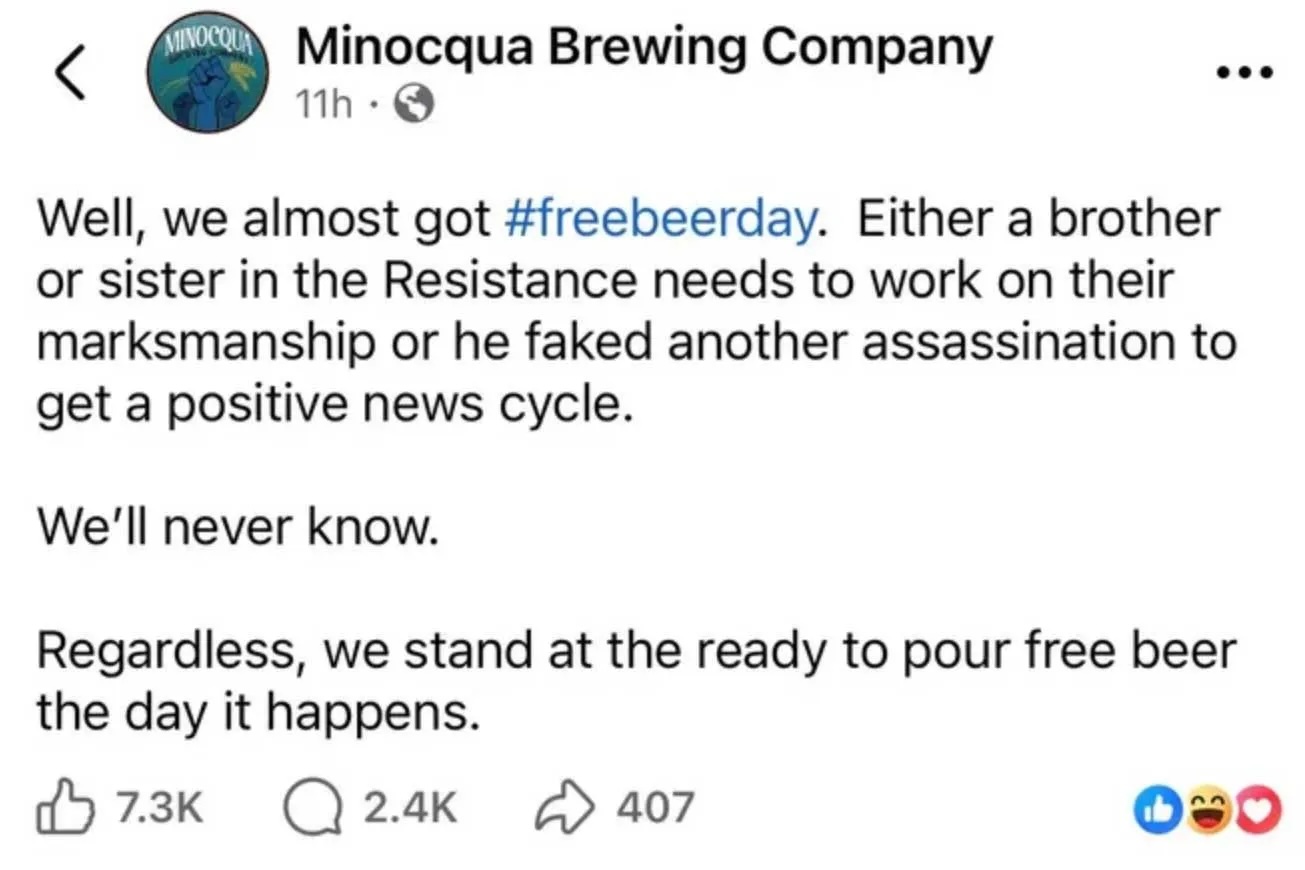
This announcement stated: “Well, we almost got #freebeerday. Either a brother or sister in the Resistance needs to work on their aim or he faked another assassination to generate a favorable news cycle. We may never know.”
Subsequently, the US Secret Service and FBI interviewed Bangstad regarding that post. Although no criminal charges emerged from the discussions, the phrasing of the post contributed extra scrutiny from both federal agencies and the public toward the brewery.
Despite the uproar over the Trump-related posts, the permit-related violations pertained to the operational aspects of the brewing business. They were not seen as penalties for the brewery’s political expression or for providing free beer.
Wisconsin Public Radio reported that the cited violations included operating an unapproved retail outlet, violating alcohol shipping regulations, and storing untaxed beer in a warehouse that lacked the necessary permit.
Bangstad mentioned that state officials confiscated beer produced in Illinois. He asserted that these issues were minor and could be rectified without revoking the company’s permits, while the state contends that all permit holders must adhere to the same alcohol regulations as every other brewer.
The state’s actions followed an administrative review to determine if Minocqua Brewing complied with Wisconsin’s alcohol statutes. The permits in question encompass far more than just the ability to serve beer in a taproom.
The Wisconsin Department of Revenue’s guidance on brewer’s permits indicates that such a permit can grant authorization for beer production, bottling, packaging, storage, shipping, delivery services, restaurant management, and retail sales at designated locations.
This differentiation is significant as the state did not simply revoke a local bar license due to a controversial advertisement. It issued notices related to brewer’s permits for the operations in Minocqua and Madison, plus a warehouse permit associated with one of these sites.
In response to inquiries about the enforcement actions, the Wisconsin Department of Revenue stated: “The Division of Alcohol Beverages is committed to the fair and consistent enforcement of alcohol regulations within Wisconsin.”
The department further elaborated: “The division is obliged to follow and enforce state law, which includes ensuring that permit holders and licensees adhere to all relevant laws and regulations. Appropriate actions are taken when these laws are not adhered to.”
The notices did not require the brewery to cease operations immediately while it contested the decision. The department clarified that Minocqua Brewing has until August 4, 2026, to file an appeal and can continue its operations during that appeal.
The brewery faces permit revocation; however, the appeal process creates a significant interval between the receipt of the notice and the loss of legal operating capacity. Minocqua Brewing is able to contest both the alleged violations and the penalties before any final decision is made.
During this process, Bangstad can present documentation, dispute the state’s findings, and argue that the proposed punishment is excessive. The Department of Revenue will be able to defend its investigation and clarify why they believe revocation is warranted instead of a fine, warning, or lesser penalty.
If the brewery opts not to appeal or if its appeal is unsuccessful, the loss of its brewer’s permits would hinder its capacity to produce, store, transport, and sell its beer under those state licenses. Until that point, the taprooms are not automatically required to shut down simply due to the issuance of the notices.
Bangstad, a political activist who has shaped the brewery’s public persona around progressive issues, disputes the state’s characterization of the dispute as a standard enforcement action. He asserts that the investigation and proposed permit revocations are a direct response to his criticisms of Trump and Republican officials.
“As you might expect, I’m not accepting this quietly,” Bangstad communicated in a Substack post. He vowed: “We will fight the state of Wisconsin at every turn, and they’ll have to forcibly remove me from my taprooms before I cease serving beer to the thirsty progressives who come to see us.”
Bangstad has also claimed that distributors and retailers have boycotted his products due to his political stance. While he acknowledged that debts were owed to the state, he contended that the alleged infractions did not warrant the revocation of the permits vital for the company’s core operations.
The brewery is defending itself on two fronts. Its legal team can challenge whether the permit violations took place, while Bangstad can also argue that state officials have applied stricter scrutiny to his business because of its political ideology.
His defense maintains that the posts, despite their provocative and offensive nature, did not directly call for anyone to harm Trump or commit illegal acts. Bangstad classifies them as political satire protected under the First Amendment rather than a legitimate threat.
However, the permit case does not seem to assert that the posts in question violated Wisconsin’s brewing regulations. To substantiate a claim of political retaliation, the brewery would need to provide proof that regulators used standard permit regulations as a facade or treated similar businesses differently due to differing political affiliations.
A business owner does not forfeit all rights to free speech upon receiving a state permit. Bangstad retains the right to criticize Trump, support progressive agendas, and assert that his posts were satirical, all while adhering to the same laws that govern other political speech.
Simultaneously, holding a permit allows the state to enforce rules regarding beer production, storage, tax compliance, and sales locations. Protected political speech does not excuse violations of these regulations.
The central issue, therefore, is not merely whether the brewery’s remarks were offensive but whether the state has demonstrated the operational violations, whether revocation is an appropriate response, and whether political factors influenced how regulators managed the case.
Wisconsin’s alcohol regulators possess extensive authority over businesses functioning under state-issued brewer’s permits, yet their verdicts can still be contested through administrative and judicial channels.
Minocqua Brewing’s short-term prospects hinge on this process. Filing an appeal permits the company to continue operating while the dispute is ongoing, rather than forcing it to cease brewing and selling beer immediately upon receiving the revocation notices.
Bangstad has made his intentions clear to fight back. The forthcoming step involves whether the brewery will submit its appeal before the deadline and whether it can convince officials or a court that the alleged violations do not justify the loss of permits at both locations.

